Damp walls: how to find the cause in 10 minutes and what it costs to fix
Condensation, rising damp, water ingress or a plumbing leak: four signs that tell them apart, a comparison table and observed prices for each fix.
- Almost all damp on walls has one of four causes: condensation, rising damp, water ingress or a plumbing leak.
- The patch's height and shape, the season and your floor separate the causes in 10 minutes — with a tape measure and a ~€10 hygrometer.
- Costs range from €20–300 (condensation) to €35–60/m² (rising damp). Find the cause before you ask for quotes.
IN THIS GUIDE
What causes damp on walls?
When a wall is damp, the water got there by one of four routes: it condensed from the air inside your home, it rose from the ground, it came in from outside through the façade or the roof, or it escaped from a pipe. Each route leaves different marks — and each has a different fix, with prices ranging from tens to thousands of euros.
The problem is common. According to INE, Portugal's statistics institute (2025), 32,1% of residents live in homes with damp or leaks, and the country ranks 2nd in the EU on this indicator. Around 70% of the housing stock was built before thermal insulation rules, which leaves many walls cold and vulnerable.
- Condensation — water vapour in the indoor air condenses on a cold wall. It is the most common cause in Portugal and the one most often fixed without building work.
- Rising damp — water from the ground climbs through the pores of the wall, like a wick. It only happens on ground floors (rés-do-chão), in basements and in houses.
- Water ingress — rainwater gets in through the roof, the terrace, the façade or the window frames.
- Plumbing leak — a supply or waste pipe loses water inside the wall, the floor or the neighbour's flat.
How to tell the causes apart in 10 minutes
You don't need expensive equipment. You need to look carefully at the patch, a tape measure and, ideally, a hygrometer costing about €10. Answer these four questions, in this order.
- How high is the patch? A continuous band from the floor up to about 1 metre points to rising damp. Upper corners, next to the ceiling or behind furniture point to condensation. Patches on the ceiling or around windows point to water ingress. A patch in the middle of a wall, unrelated to corners or windows, suggests a pipe.
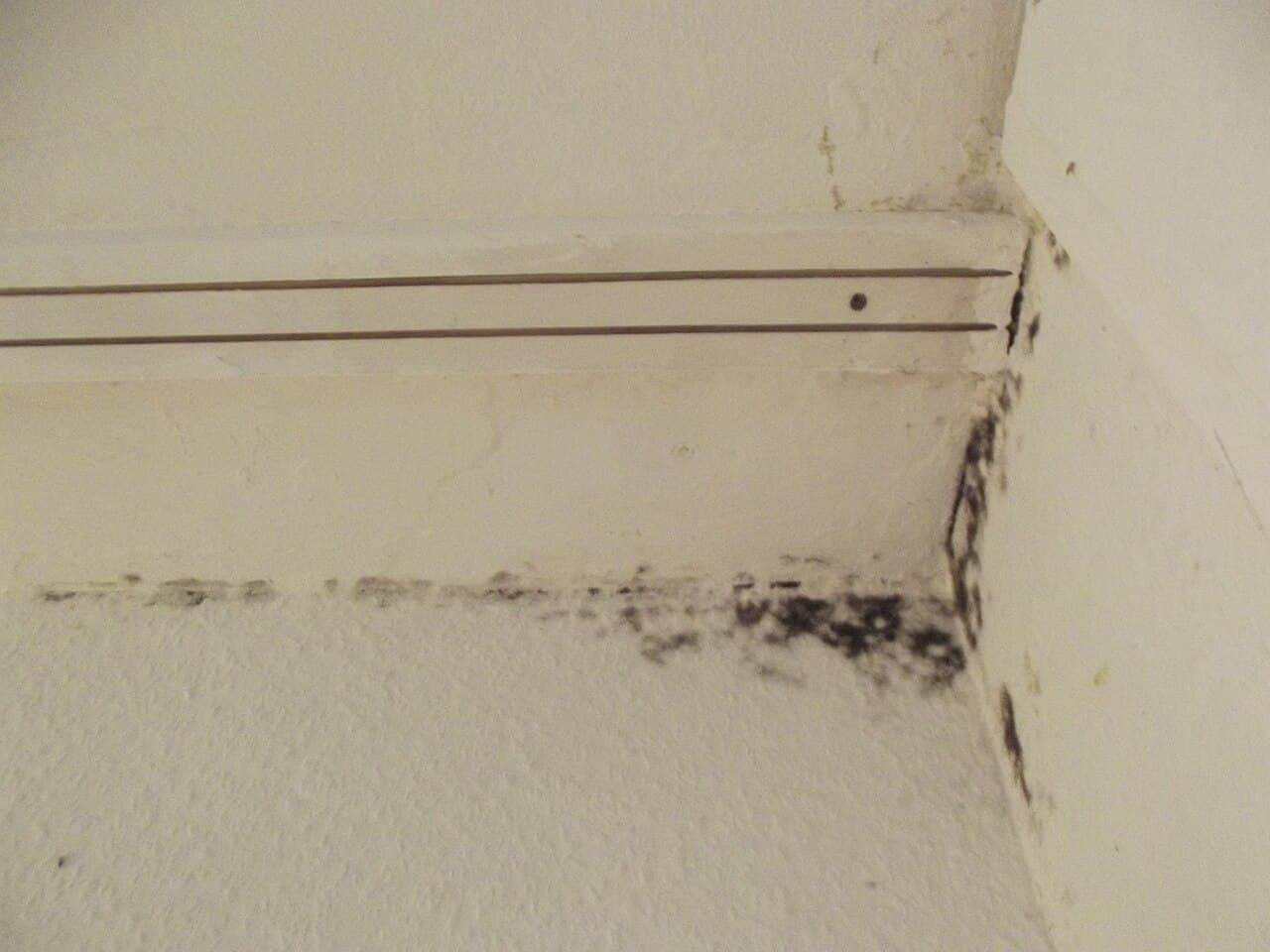
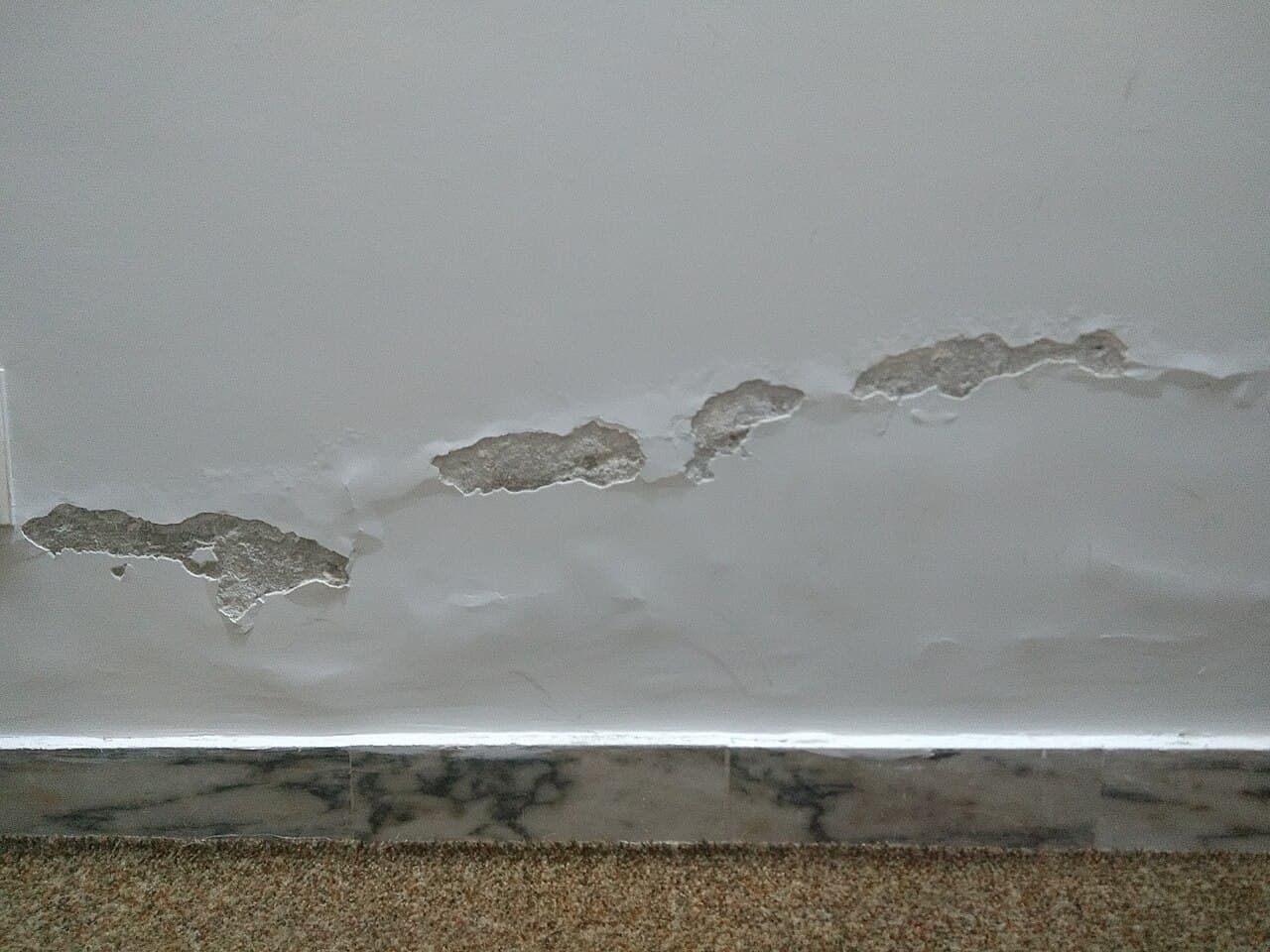
- What shape and appearance does it have? Scattered black or green dots are condensation mould. A yellow-brown ring with a sharp edge is typical of ingress or a leak. White powder (efflorescence, salitre), crumbling plaster and blistering paint near the floor are typical of rising damp.
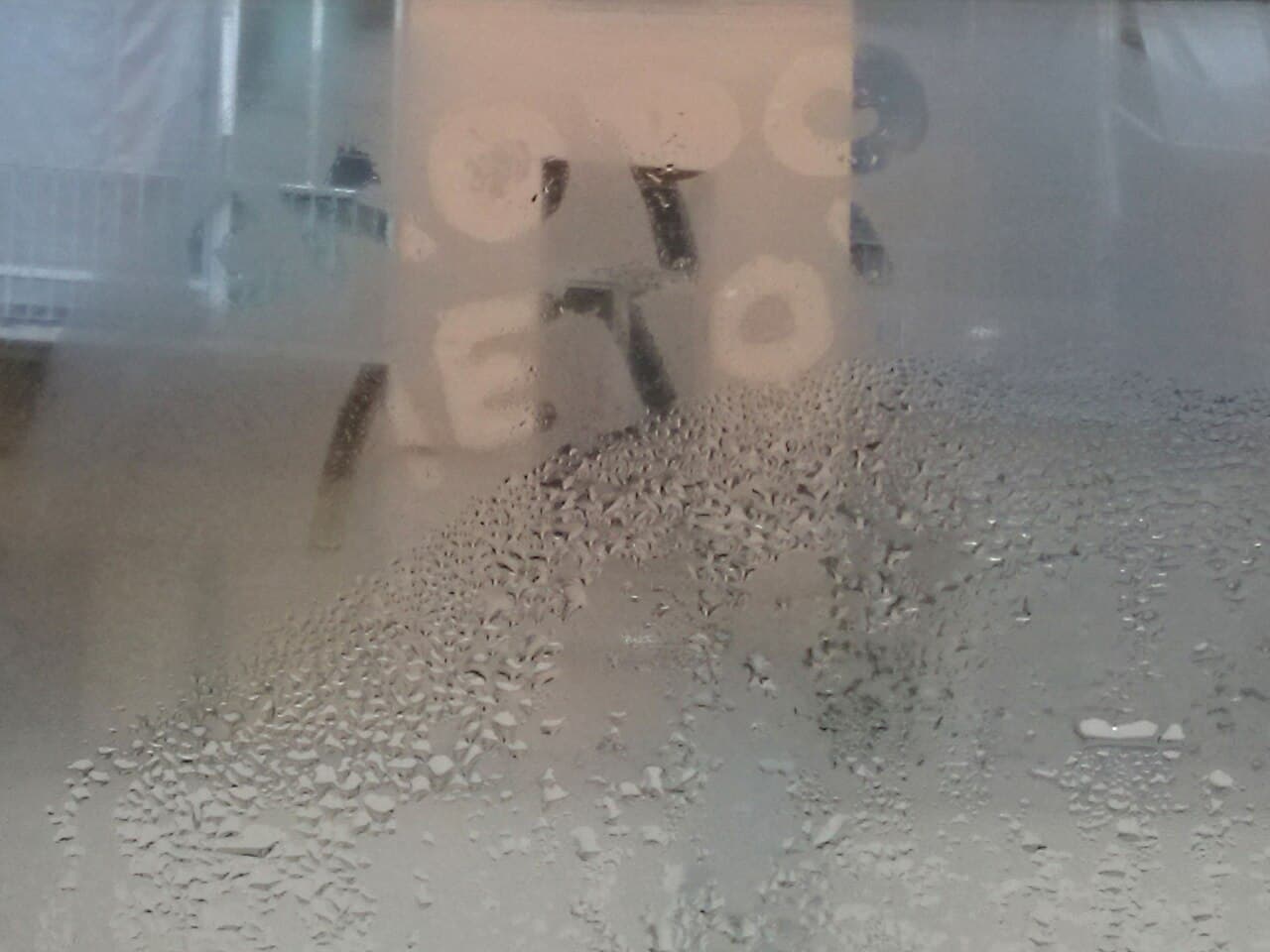
- When does it get worse? In winter, in the morning, with misted windows: condensation. One to three days after rain: water ingress. The same all year round: rising damp. It grows even in dry weather: plumbing leak.
- Which floor do you live on? Rising damp practically never happens above the ground floor. On a top floor, ingress through the roof or terrace becomes more likely. On a middle floor, condensation and leaks — yours or the upstairs neighbour's — are the main suspects.
If you have a hygrometer, measure the relative humidity at 7am, before opening the windows, in the room with the patch. Readings above 70% for several days in a row make condensation very likely. The dew point calculator shows the temperature at which the wall starts getting wet: at 18 °C and 75% humidity, the surface only needs to be at about 13,5 °C.
Condensation, rising damp, ingress or leak? The table
| Sign | Condensation | Rising damp | Water ingress | Plumbing leak |
|---|---|---|---|---|
| Where it appears | Upper corners, behind furniture, around windows | Band up to ~1 m from the floor | Ceiling, around windows, under terraces | Near the bathroom or kitchen, at any height |
| Appearance | Black or green dots | Salts, crumbling plaster | Ring with a sharp edge | Spreading patch, sometimes with a ring |
| When it's worse | Winter, mornings | Same all year | 1–3 days after rain | Also in dry weather |
| Typical floor | Any | Ground floor, basement, house | Top floor, exposed façades | Any, including under another flat |
| Quick test | RH above 70% at 7am | Only near the floor, never upstairs | Photos before and after rain | Water meter moving with everything off |
Causes also mix. A ground-floor wall can have rising damp at the bottom and condensation in the upper corners; a ceiling can have an old leak with condensation mould around it. That is why our diagnosis doesn't give a single answer: it calculates a probability for each cause, flags a possible leak and, when confidence is low, recommends a technical visit.
How to confirm a plumbing leak
A leak is the cause most often confused with the others, because it can appear on any wall and on any floor. The clearest sign is a patch that keeps growing through weeks without rain, especially near bathrooms, kitchens or along the pipe routes.
- Turn off every tap and make sure no appliances are running and the toilet cistern (autoclismo) isn't filling.
- Photograph the water meter with your phone.
- Wait one to two hours without using any water and photograph it again. If the meter has moved, water is escaping somewhere.
- If the patch is on the ceiling, talk to your upstairs neighbour and ask them to do the same test.
The meter only detects leaks on the supply side. Waste leaks — traps, drain pipes, the shower tray — only lose water when the fixture is used: if the patch grows after showers, suspect the drains or the shower seals. See also the guide on damp coming from the upstairs neighbour.
How much does it cost to treat damp walls?
The price depends mostly on the cause — and this is where a wrong diagnosis gets expensive. The ranges below were observed on Google.pt, cume.pt, Zaask, Habitissimo and in customer reports in October 2026.
| Cause | Fix | Observed price |
|---|---|---|
| Condensation | Airing, dehumidifier, absorbers, window film | €20–300 (DIY) |
| Persistent condensation | PIV (positive input ventilation, VMI) in a flat | ≈ €800–2 500 (estimate) |
| Persistent condensation | MVHR/mechanical ventilation (VMC) | ≈ €2 500 or more |
| Rising damp | Injections or electro-osmosis | €35–60/m² of wall |
| Rising damp | «Whole-house» systems | €4 500–20 000 (customer reports) |
| Ingress through a terrace | Waterproofing | €28–45/m² |
| Plumbing leak | Leak detection | from a few hundred € |
| Mould (symptom) | Professional cleaning | from €48 |
An example: a 6 m wall with a 1 m band of rising damp is 6 m², or €210–360 for the treatment alone — without removing the old plaster, new plaster or painting. Always ask for the price per m² and what's included. There's more detail in how much rising damp treatment costs and on the injection prices page.
The marketplaces contradict each other — Zaask quotes €4–50/m², Habitissimo an average of €157,50/m² — which says a lot about how opaque this market is. The public subsidies E-Lar and Vale Eficiência have been closed since July 2026, with no new schemes announced.
What you can do now, before calling anyone
- Move wardrobes and beds 5–10 cm away from outside walls and air the home for 5–10 minutes each morning with opposite windows open.
- Avoid drying laundry indoors without a dehumidifier: a family of four already puts about 10 litres of water into the air every day.
- Clear gutters and terrace drains, and check whether the ground outside is higher than the floor inside.
- Photograph the patch every week, with the date and a tape measure beside it, to see whether it grows.
- Clean visible mould with diluted bleach (1 part to 4 of water), wearing gloves and a mask with the window open, never mixing it with other products.
Use biocides safely. Always read the label and product information before use.
Don't paint over it with «anti-damp» paint before you know the cause. On a wall with rising damp, sealing the pores pushes the water and salts higher; on a wall with condensation, the mould returns as soon as the paint stops working.
When to call a professional — and which one
Call someone when the diagnosis points to rising damp or ingress, when you suspect a leak, or when you've done everything above for 2–3 weeks and the humidity at 7am is still above 70%. The lower the confidence of the diagnosis, the more sense a technical visit makes before any work.
- Plumbing leak: a plumber (canalizador) with leak-detection equipment.
- Ingress through the roof, terrace or façade: a builder or waterproofing company. If it's a common part, it's a matter for the condomínio (the owners' association).
- Rising damp: a damp-treatment company — ask for two quotes using different methods.
- Persistent condensation: a ventilation installer (PIV or MVHR).
Many companies offer a free visit and sell their own system — the diagnosis and the work come from the same source. Take your photos and readings, use the questions in the guide on how to choose a damp company, and check they hold an alvará or contractor certificate from IMPIC (the construction regulator), insurance and a written guarantee. If you rent, see who pays for the repairs.
Frequently asked questions
As a rule, condensation damages finishes: paint, plaster, skirting boards and woodwork. Ingress and leaks that last for years are more serious, because they can rot timber floors and roof structures and degrade plaster and mortar deep down. Cracks with water, bulging ceilings or soft timber justify a prompt technical visit, ideally by someone who doesn't sell the treatment.
Only when the cause is condensation. In that case, bringing the air down to 50–55% humidity stops water condensing on cold walls. Against rising damp, ingress or a leak, the unit fills its tank every day but the wall stays wet, because the water keeps arriving by another route.
It depends on thickness and material. A brick wall with a one-off leak may dry in a few weeks; a thick stone wall treated for rising damp can take many months. It's best to wait for the wall to dry before replastering or painting, and to use materials that let it breathe.
Multi-risk home policies usually include «danos por água» (water damage) from sudden events, such as a burst pipe. Gradual ingress, condensation and lack of maintenance are often excluded. Check the particular conditions of your policy and report the claim as soon as you notice the problem, with photos and dates.
As a rule, the façade, roof and structure are common parts under the Código Civil (Civil Code), art. 1421, and maintenance costs are shared by the owners in proportion to their permilagem (ownership share), art. 1424. Repairing damage inside the unit (fração) may follow other rules. Check your case with a lawyer or with DECO, the consumer association.
SOURCES
- INE — Survey on Income and Living Conditions, 2025 (via idealista)
- Eurostat — population living in dwellings with damp or leaks, 2023
- Building physics: dew point (Magnus formula)
- Prices observed on Google.pt, cume.pt, Zaask and Habitissimo and customer reports, Oct 2026
- Código Civil (Civil Code), arts. 1421 and 1424