Damp coming from the upstairs neighbour: what to do
A patch on your ceiling under the neighbour's bathroom? How to confirm the source, talk, notify in writing and claim on insurance.
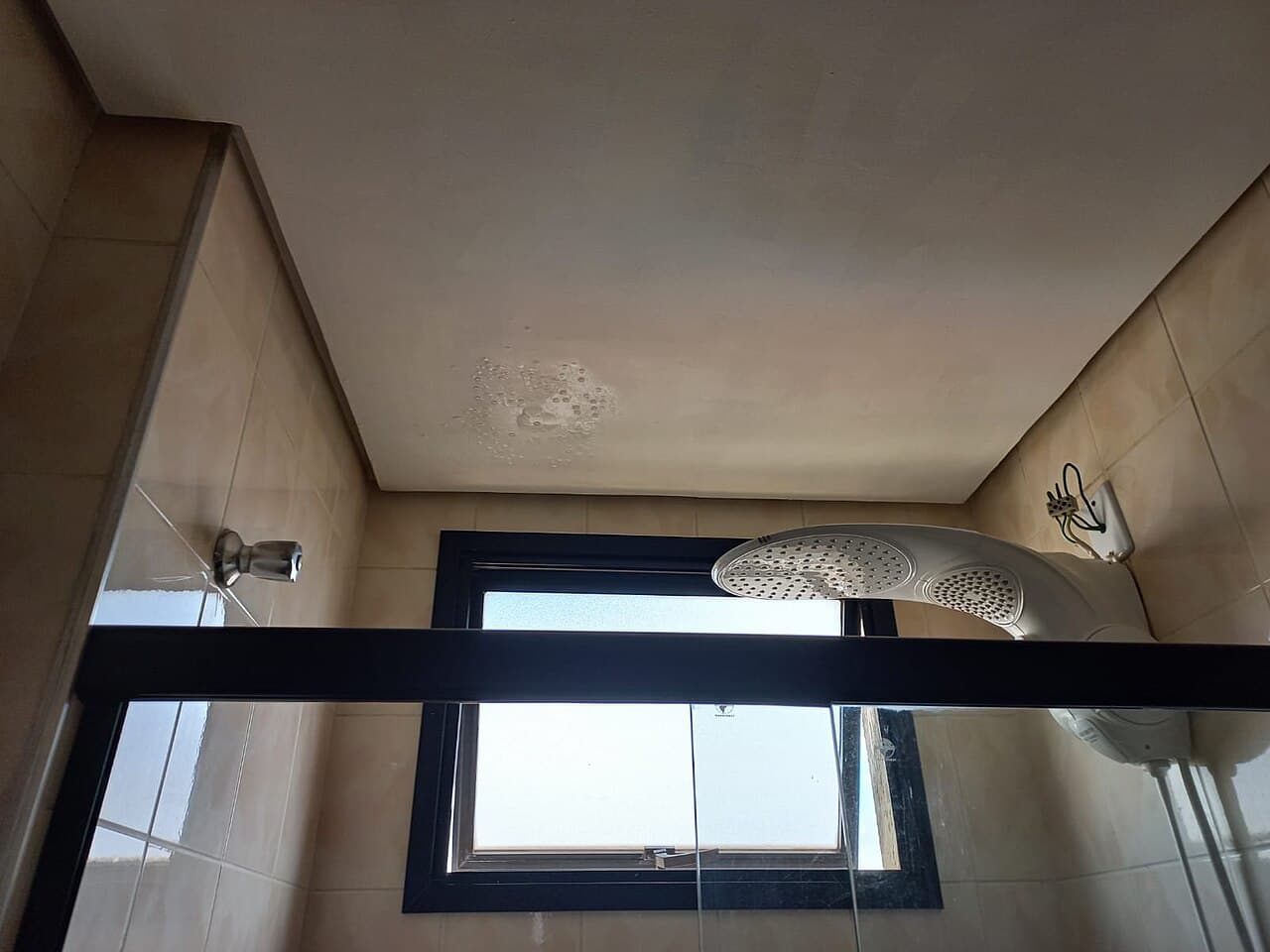
- A ring-shaped ceiling patch under the bathroom or kitchen upstairs that grows without rain points to a leak or failed seal above.
- Talk to the neighbour first and ask for the meter test: everything off and the water meter still for 30–60 minutes.
- If nothing happens, notify in writing, claim on your insurance (water damage) and, if the pipe is shared, tell the condomínio.
IN THIS GUIDE
How do you know the damp comes from the upstairs neighbour?
In a fração (unit) on a middle floor, a ceiling patch has few possible sources: the neighbour's home above, a shared pipe running between floors, or condensation. If you live on the top floor, the roof joins the list — see the guide on mould on the ceiling.
The signs pointing upstairs are fairly characteristic:
- A ring-shaped patch (yellowish or brownish edge) under the neighbour's bathroom, kitchen or washing machine area.
- It grows irregularly, with no link to rain — sometimes it darkens after someone showers upstairs.
- Blistered paint, drops or crumbling plaster, rather than black spots spread across the corners.
- It appears suddenly, after building work or the replacement of an appliance upstairs.
| Sign | Leak upstairs | Ceiling condensation | Water ingress through the roof |
|---|---|---|---|
| Shape | Ring with a marked edge | Diffuse black spots, in corners | Ring, often near external walls |
| When it gets worse | No rain pattern; after showers upstairs | In winter, in the morning | After rain |
| Which floor | Any floor with a unit above | Any floor | Top floor |
| To the touch | Damp, sometimes wet | Cold, damp surface | Damp after rain |
The free diagnosis cross-checks these signs and gives a probability for each hypothesis, with a leak alert when your answers justify it. For the full method, see the guide on water ingress.
The meter test: how to confirm a leak
The simplest test uses the neighbour's water meter, not yours. Ask them to turn off every tap, not use the toilet cistern or appliances, and note the meter reading. After 30 to 60 minutes, read it again. If the meter has moved with everything off, there is a leak in that unit's supply.
If the meter stayed still, a leak in the pressurised pipework is unlikely, but waste-water or seal leaks are not ruled out: worn shower-tray joints, bath silicone, the trap or the toilet connection. These only let water through when they are used.
If none of this gives a clear answer, professional leak detection (thermal imaging, tracer gas, camera) costs from a few hundred euros. It can be worth it before breaking open ceilings or floors at random.
Talk to the neighbour first
Most of these cases are solved with a conversation. The neighbour often doesn't know they have a leak. Bring photos of the patch, explain when it appeared and suggest doing the meter test together.
If the person upstairs is a tenant, repairing that unit's plumbing is, as a rule, their landlord's job. Ask for the owner's contact or ask the building management. And if you are a tenant, tell your own senhorio (landlord) too: repairing your ceiling is, in principle, their matter — see who pays in a rented home.
If relations between neighbours are already tense, you can ask the building management to act as a go-between or to be present at the first conversation. It is not compulsory, but a third person helps keep the discussion on the facts: the patch, the dates and the test.
Notify in writing: what to include
If the conversation doesn't solve it within a few days, or the neighbour doesn't reply, put it in writing. A registered letter with proof of receipt or an email with a read receipt records that the neighbour was informed — which may matter if the damage grows.
- The date the patch appeared and where it is (which room, and under which of the neighbour's rooms).
- Dated photos and, if you have them, humidity readings.
- What you are asking for: a check of the plumbing or seals and a repair within a reasonable time, for example 15 days.
- That you intend to report the claim to your insurer, and a request for the neighbour's policy details.
The template letters the site generates are designed for landlords and building management — they are on the tenants and condominium pages and in the diagnosis result. They are a good base for structuring a letter to the neighbour. They are templates, not legal advice.
Insurance: "danos por água" and who claims
Home multi-risk policies usually include water damage cover (danos por água), designed for sudden events such as a burst pipe or an overflowing machine. Slow leaks and lack of maintenance are often excluded. Check the specific conditions (condições particulares) of your policy.
As a rule, three policies may be involved: yours (damage to your ceiling and contents), the neighbour's (damage to their home and, if they have it, third-party liability for damage caused to others) and the condomínio's, if the source is a shared pipe. Often the quickest route is to claim on your own insurer, which then deals with the neighbour's.
When the pipe is shared: the building management
Water and waste stacks serving several units are, as a rule, common parts of the building (Código Civil, art. 1421), and their upkeep is paid by the owners in proportion to their permilagem (share of the building, in thousandths) under art. 1424. If the neighbour's meter test is negative and the patch is next to a stack, that may be the source.
In that case, the notice goes to the condomínio's management, with a copy to the neighbour. The branch pipe inside each unit is usually the unit owner's responsibility; the exact boundary may depend on the building's rules. More in the guide on common parts.
No agreement: mediation, Julgados de Paz and realistic timelines
When the neighbour refuses or ignores you, there are alternatives before the ordinary courts. The Julgados de Paz (justice of the peace courts) handle disputes between neighbours and between unit owners, with simple procedures, low costs and a mediation stage. Check with DECO or with your local julgado whether your case falls within their remit.
| When | What to do |
|---|---|
| Day 0 | Photograph, tell the neighbour, protect belongings if water is dripping |
| Days 1–3 | Meter test; report the claim to your insurer |
| Days 3–7 | No reply: registered letter or email with receipt |
| Within 15 days | Plumber visit or insurer's assessment |
| After the repair | Let the ceiling dry for several weeks before painting |
| No agreement | Mediation, DECO or Julgados de Paz |
Once the leak is fixed, a plaster ceiling can take weeks to dry. Painting too early brings the stains back. This article is general information, not legal advice: if in doubt, talk to a lawyer or to DECO.
Frequently asked questions
There is no simple rule forcing the neighbour to open the door at any time. In practice, the insurer's assessor or a plumber called by the neighbour solves most cases. If refusal persists and the damage continues, keep evidence of your attempts and get advice: DECO, a lawyer or the Julgados de Paz can point you to the possible next steps.
As a rule, whoever caused the damage is responsible for the repair, including plaster and paint. If the neighbour has third-party liability cover, or your policy covers water damage, the insurer may pay, minus the excess. Check the specific conditions of the policy. If you are a tenant, speak to your landlord first.
Contact the building management, which usually has the owner's details, and keep everything in writing. Report the claim to your insurer with dated photos. If water is running and nobody can shut off that unit's supply, call the fire brigade (bombeiros). Keep a record of every contact attempt, with dates.
It can. Many policies exclude gradual damage and lack of maintenance, and a patch that grew for months without being reported raises that question. That is why it pays to report as soon as you notice the problem, with dated photos. If you disagree with the decision, ask for the reasons in writing and check the policy conditions.
It depends on the amount of water, the material and the ventilation. A plaster ceiling may need several weeks; a concrete slab that was soaked, longer. Measure the room's humidity, air it and, if it helps, use a dehumidifier. Paint only when the patch has stopped growing and the surface has been dry to the touch for several days.
SOURCES
- Código Civil (Civil Code), arts. 1421 and 1424 (horizontal property)
- Lei dos Julgados de Paz (Justice of the Peace Courts Act, Law 78/2001, as amended)
- Prices observed on Google.pt, cume.pt, Zaask and Habitissimo, Oct 2026