Damp in the common parts of a condominium: who pays and what to do
Façade, roof, terrace or stacks: when the condominium pays, how to get it onto the meeting agenda and what to do if it is urgent.
- Façade, roof, structure and shared pipes are, as a rule, common parts of the building (Código Civil, art. 1421).
- Repairs are paid by all owners in proportion to each unit's permilagem (art. 1424), unless the building has its own rules.
- Ask the management in writing to put it on the meeting agenda; urgent repairs can go ahead sooner (art. 1427).
IN THIS GUIDE
When is damp the condominium's problem?
When water gets in through a part of the building that belongs to everyone. Under horizontal property (propriedade horizontal), each owner (condómino) owns their fração (unit) and co-owns the common parts. If the water comes through the façade, the roof, a roof terrace or a waste stack, the repair is, as a rule, a matter for the condomínio (owners' association) — even if the patch only shows up in one home.
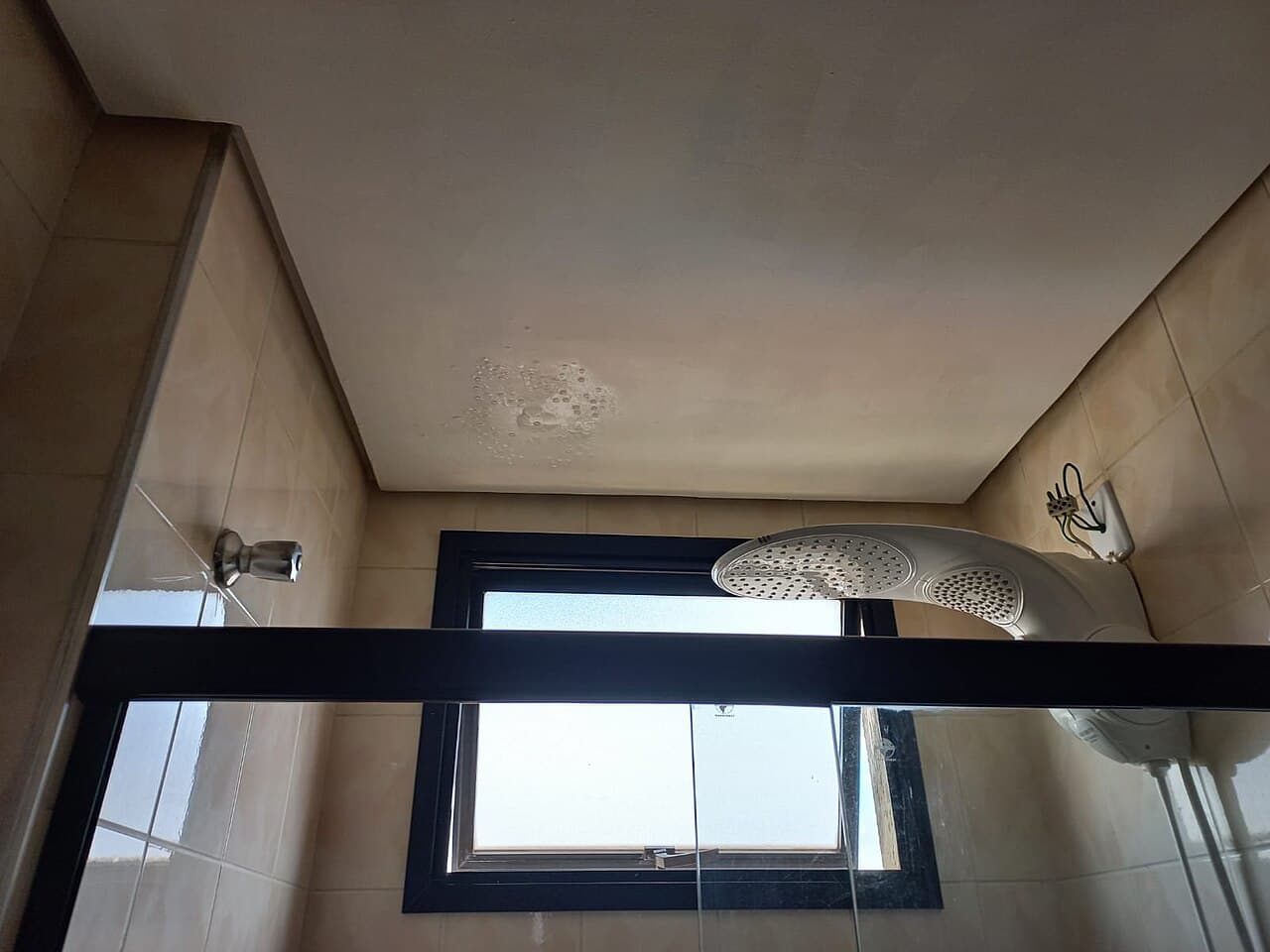
A typical case: a third-floor flat in a 1970s block, with patches on the bedroom's external wall after every storm, because the façade is cracked and the render has come loose. Another: the top floor with a ring-shaped ceiling patch, under a roof nobody has inspected for years.
Signs pointing to the common parts:
- The patch gets worse with wind-driven rain and improves in dry spells.
- It is on an external wall, on a top-floor ceiling or next to a waste stack.
- Neighbours in the same vertical line of units have the same problem.
- You can see cracks, loose render or broken gutters when you look at the building from the street.
What counts as a common part (art. 1421)
Article 1421 of the Código Civil (Civil Code) lists the common parts of a building. Some always are; others are presumed common unless the deed assigns them to a unit. The table sums up the elements most often behind damp.
| Element | As a rule | Notes |
|---|---|---|
| Structure (columns, beams, load-bearing walls) | Common | Structural cracks are a condominium matter |
| Façade and external walls | Common | Includes the external render and cladding |
| Roof | Common | Even if it only protects the top floor |
| Roof terrace | Common | If one unit has exclusive use, cost sharing may differ |
| Water, waste and gas stacks | Common | Branch pipes inside each unit are, as a rule, the owner's |
| Garage and storage rooms | Depends on the deed | They may be common or separate units |
| Windows and frames | The unit's | Changing the façade's appearance usually needs approval |
Before blaming the building, rule out condensation, which appears in the same places — external walls and top-floor ceilings — and is not a defect of the common parts. The free diagnosis tells the hypotheses apart; see also the guide on water ingress.
Who pays: the permilagem (art. 1424)
Upkeep costs for the common parts are paid by the owners in proportion to the value of their units — the permilagem (share in thousandths), set out in the deed. A unit at 80‰ pays 8% of the work; one at 40‰ pays 4%. This also applies to owners with no damp at home, except for special rules on parts that serve only some owners.
An example using observed prices: waterproofing 120 m² of roof terrace at €28–45/m² costs €3,360–5,400. For a unit at 50‰, its share would be €168–270. See the detail in how much terrace waterproofing costs.
How to get the damp onto the meeting agenda
Work on the common parts is decided at the owners' meeting (assembleia de condóminos). To get the issue there with a chance of approval:
- Document it: dated photos, where the damp is, when it gets worse (after rain, in strong wind), readings if you have them.
- Write to the management by registered letter or email with receipt, describing the problem and asking for a technical assessment and for the item to be added to the agenda of the next meeting.
- Ask for an extraordinary meeting if the problem cannot wait for the ordinary one, which as a rule meets once a year.
- Bring a quote or a technical opinion to the meeting. Without numbers, the issue is often postponed.
- Ask for the minutes (ata) after the meeting. They prove what was decided, the deadlines and how the costs are split.
The site generates a free template letter to the management, from your diagnosis result or on the condominium page. It states the unit, the affected rooms, how long it has been going on and the likely cause, and asks for a technical assessment and inclusion on the agenda. It is a template, not legal advice: adapt it to your case.
Urgent repairs to common parts (art. 1427)
Some situations cannot wait for the meeting: a broken waste stack, lifted roof tiles before a week of rain, water running into the fuse box. Article 1427 of the Código Civil allows essential and urgent repairs to the common parts to be carried out on the initiative of any owner, when the administrator is absent or unable to act.
In practice: tell the management first, in writing and by phone. If there is no reply and the damage is growing, do only what is essential to stop the water — a temporary fix, not the full job. Keep invoices and photos and inform the management immediately. Reimbursement by the other owners is discussed afterwards.
Document the urgency as you would everything else: photos of the damage before and after, the time you notified the management and the reply (or lack of one). That is what shows, later, that it could not wait for the meeting.
Tenants and owners: who talks to whom
Only the owner (condómino) votes at the meeting. If you are a tenant and the damp comes from a common part, your relationship is with the senhorio (landlord): notify them in writing and ask them to contact the management. You can send a copy to the management so it is informed. More in who pays in a rented home and on the tenants page.
If you are an owner letting the home, ensuring the tenant can use it remains your obligation (art. 1031), even when the condominium is the one that has to repair. It pays to follow the process closely and keep the tenant informed of timelines.
| Who you are | Who you talk to | Key document |
|---|---|---|
| Tenant | Landlord (copy to the management) | Letter with photos and report |
| Resident owner | Building management | Letter and request to add the item to the agenda |
| Owner-landlord | Management and tenant | Letter to the management and a log of deadlines |
What if the condominium does nothing?
First, keep insisting in writing and keep the replies. If there is damage inside your unit — plaster, paint, furniture — report it to your insurer and inform the management. Some condominiums have a building policy with water damage cover; others only have the fire insurance required by law. See what home insurance covers.
If the management doesn't act or the meeting rejects necessary work, there are options: mediation, the Julgados de Paz (justice of the peace courts, which handle disputes between owners and with the condominium at low cost) or the courts. Talk to DECO or a lawyer before choosing.
Frequently asked questions
It depends. The slab and the balcony's structural elements are usually considered common, while the floor finish and its use normally belong to the unit. Court decisions do not always agree, and the deed may say otherwise. Check the deed and the building's rules, and confirm with the management or a lawyer before taking on the work.
As a rule, yes. The roof is a common part and upkeep costs are shared among all owners in proportion to their permilagem, even if the leak only affects the top floor. There are special rules for parts serving only some owners, so check the deed and previous decisions of the owners' meeting.
If the source is a common part, the condominium may also have to answer for damage caused inside the unit, such as plaster and paint. It depends on the proven source and, often, on the building's insurance. Document it with dated photos, report it to your insurer and ask the management for the condominium's policy details.
Make the request in writing and keep proof of sending. If it is refused or ignored, the Código Civil allows owners representing a share of the building's value to call the meeting themselves. The exact conditions and the form of the notice should be confirmed with a lawyer or DECO so that the meeting is valid.
As a rule, not without approval from the owners' meeting: the façade is a common part and working on it on your own can cause disputes and may not entitle you to reimbursement. The exception is essential and urgent repairs under article 1427, limited to what is needed to stop the damage. Even then, tell the management first and check with a lawyer.
SOURCES
- Código Civil (Civil Code), arts. 1421, 1424 and 1427 (horizontal property)
- Código Civil (Civil Code), art. 1031 (landlord's obligations)
- Prices observed on Google.pt, cume.pt, Zaask and Habitissimo, Oct 2026