Mould on the ceiling: condensation or water ingress?
On the ceiling, the two causes overlap. How to tell them apart by shape, colour, floor and timing — and where to start.
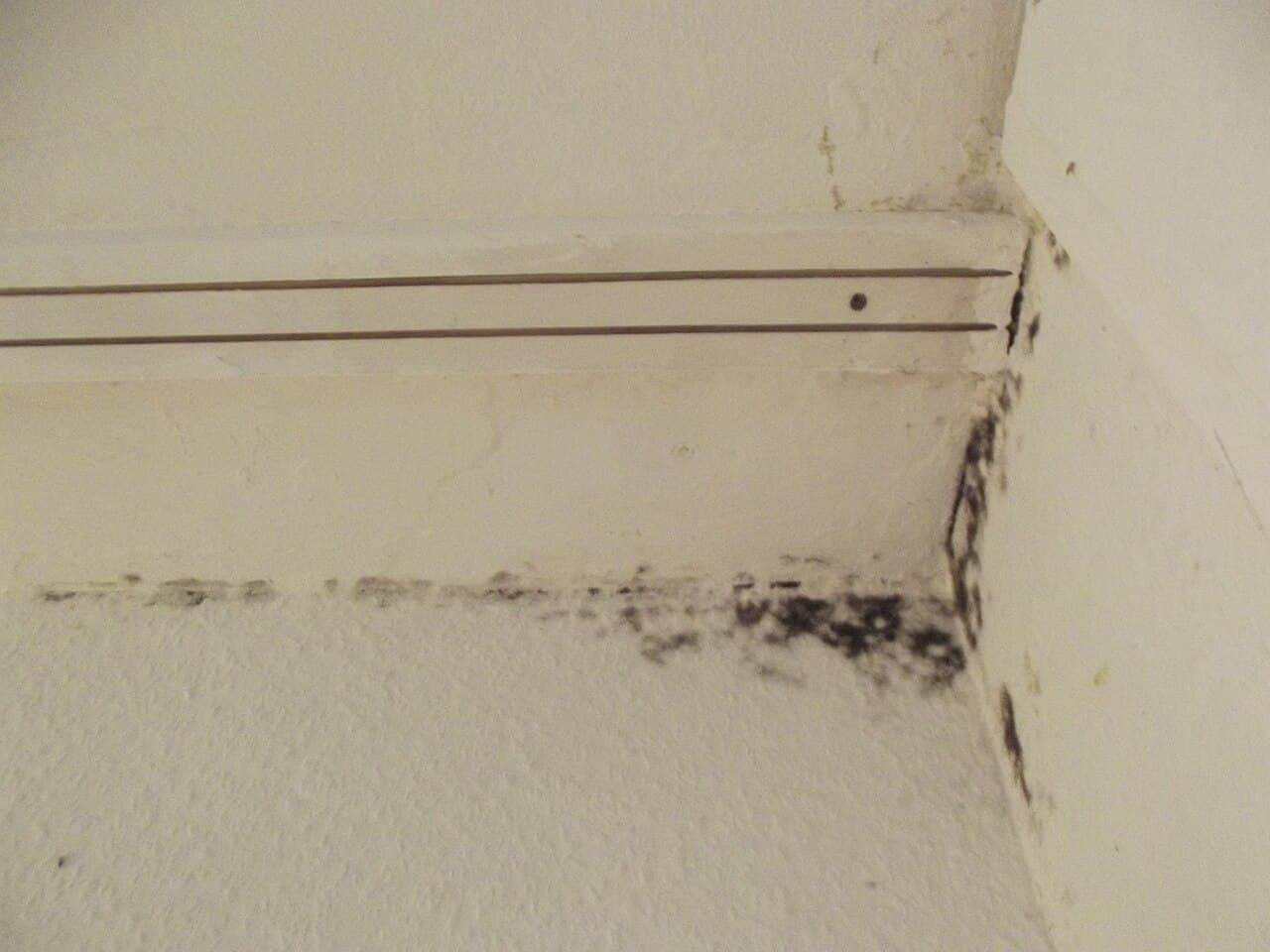
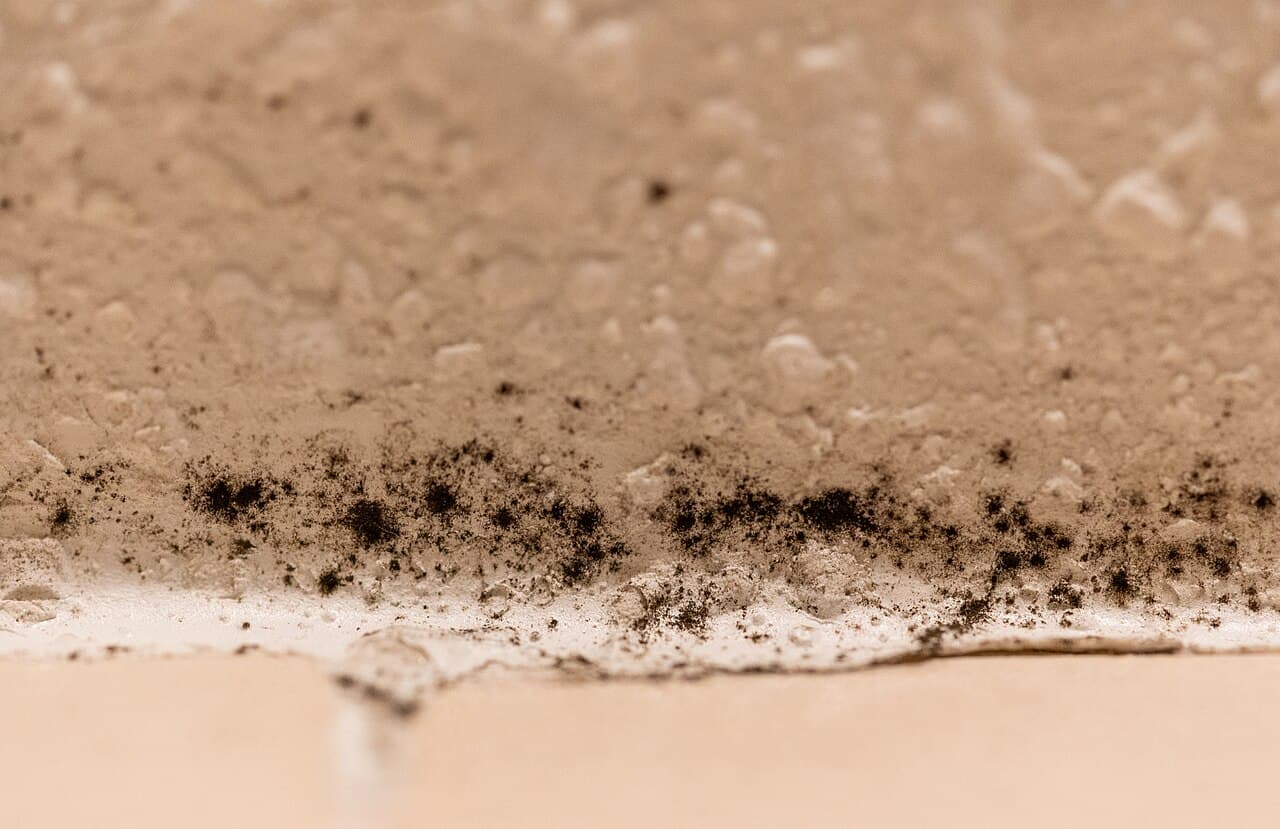
- Diffuse black spots near the outside wall, worse in winter, are almost always condensation.
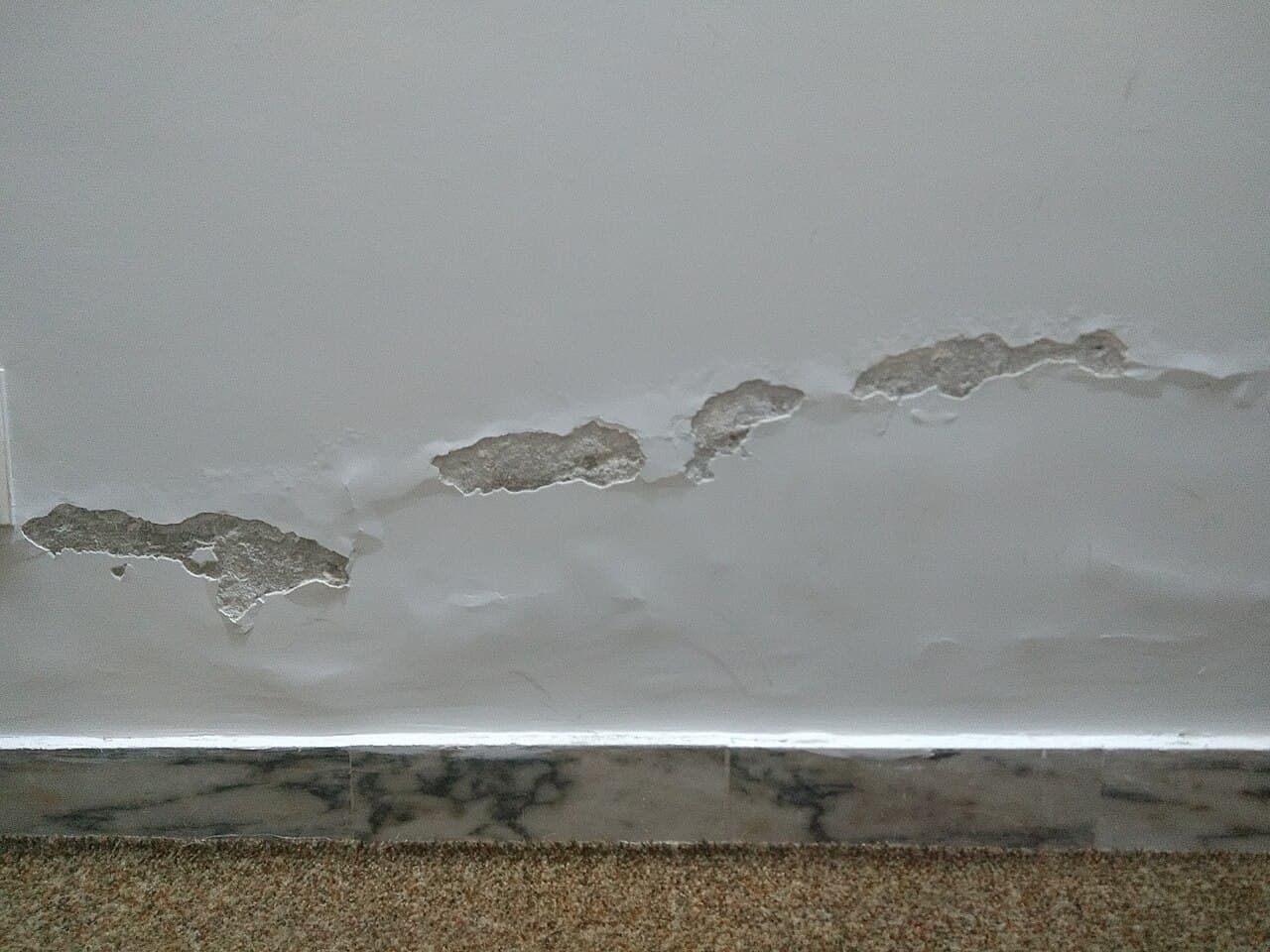
- A brown tide mark with a sharp edge that appears after rain or grows in dry weather points to water ingress or a leak.
- On a top floor both causes can coexist; on a middle floor, think of the neighbour above or the slab's thermal bridge.
IN THIS GUIDE
Mould on the ceiling: condensation or water ingress?
In most cases you can tell by looking at three things: the shape of the patch, its colour and when it appears. Scattered black spots with no clear edge, next to the outside wall and worse between November and March, are almost always condensation. A yellow-brown tide mark with a sharp edge that shows up after rain or keeps growing points to water getting in.
The ceiling is confusing because two things meet there: warm, humid air rises and hits the coldest surface in the room, and it is also the first place that water from above passes through — from the roof, a terrace or the neighbour's flat.
| Sign | Condensation | Water ingress or leak |
|---|---|---|
| Appearance | Diffuse black spots | Yellow-brown tide mark with an edge |
| Where | Corners and a strip along the outside wall | Anywhere, often in the middle |
| When | Winter, worse in the morning | After rain, or unrelated to the weather |
| To the touch | Cold surface, sometimes damp | Soft plaster, blistering paint, sometimes dripping |
Top floor or middle floor: what changes
The floor you live on is the first clue. On a top floor, above the ceiling there is the roof or a terrace. Rain can get in through broken tiles, flashings, blocked gutters or the terrace's waterproofing. At the same time, in many 1960s–80s buildings the roof slab has no insulation and gets very cold in winter, which also causes condensation.
On a top floor both causes can coexist: a tide mark after heavy rain and, on the rest of the ceiling, black spots in January. So it pays not to assume either one straight away.
On a middle floor, there is no rain directly above. A ceiling patch almost always has one of three origins: condensation at the thermal bridge next to the façade, a leak in the flat above, or a shared pipe running through the ceiling. If you live on the ground floor or in a basement, the logic is different — see the guide to damp in basements and ground floors.
A strip of mould along the outside wall: the slab's thermal bridge
A very common pattern in uninsulated buildings is a strip of mould on the ceiling, 20–40 cm wide, right against the outside wall and heavier in the corners. This is where the concrete slab meets the façade. Concrete conducts cold well, and that edge sits several degrees below the rest of the room.
You can check with a €15–20 infrared thermometer. If the room is at 18 °C with 75% humidity, the dew point is ≈13.5 °C. If the ceiling corner reads 12–13 °C in the morning, water condenses there. Run the numbers for your home with the dew point calculator.
What helps: bringing humidity down to 50–60%, airing for 5–10 minutes in the morning, keeping heating reaching that area and not covering the corner with floor-to-ceiling curtains. The long-term fix is external wall insulation, which in a building is a decision for the condomínio (owners' association), because the façade is, as a rule, a common part (Código Civil (Civil Code), art. 1421). More on the mechanism in condensation damp.
Roof and terrace: signs of water ingress through the ceiling
Water coming in through the roof or a terrace usually shows up hours to days after heavy rain, especially with wind. In dry weather the patch dries, but leaves brown rings — each downpour adds one. The paint blisters, the plaster goes soft and, in more advanced cases, it drips.
- A patch that appears or grows after rain, especially with southerly or south-westerly wind.
- Concentric yellow-brown rings, sometimes with white salts.
- A patch beneath a terrace, gutter, flashing or downpipe.
- Little relation to temperature: it appears in October as much as in March.
Terrace waterproofing costs about €28–45/m² in prices observed in October 2026 — see how much terrace waterproofing costs. In a building, the roof and many terraces are common parts, and repairs are, as a rule, paid by the condomínio, split according to each unit's share (permilagem) (arts. 1421 and 1424). The guide to water ingress explains how to gather evidence before contacting the building management.
Ceiling stain and the neighbour above
On a middle floor, a tide mark that grows even in dry weather, beneath the neighbour's bathroom or kitchen, is probably a plumbing leak or a worn shower-tray seal. The patch usually gets worse after showers or the upstairs washing machine.
- Photograph the patch with the date and trace its edge in pencil.
- Talk to the neighbour and ask them to check whether their water meter moves with all taps closed.
- If the patch dries when they stop using the shower for a few days, the source is almost confirmed.
- If the leak is in a shared pipe, notify the building management in writing.
Many multi-risk home policies include "water damage" (danos por água) for sudden leaks but exclude gradual water ingress — check the specific conditions of your policy. The guide to damp from the neighbour above explains the steps in detail, and the guide to home insurance and damp what is usually covered.
Mould on the bathroom ceiling
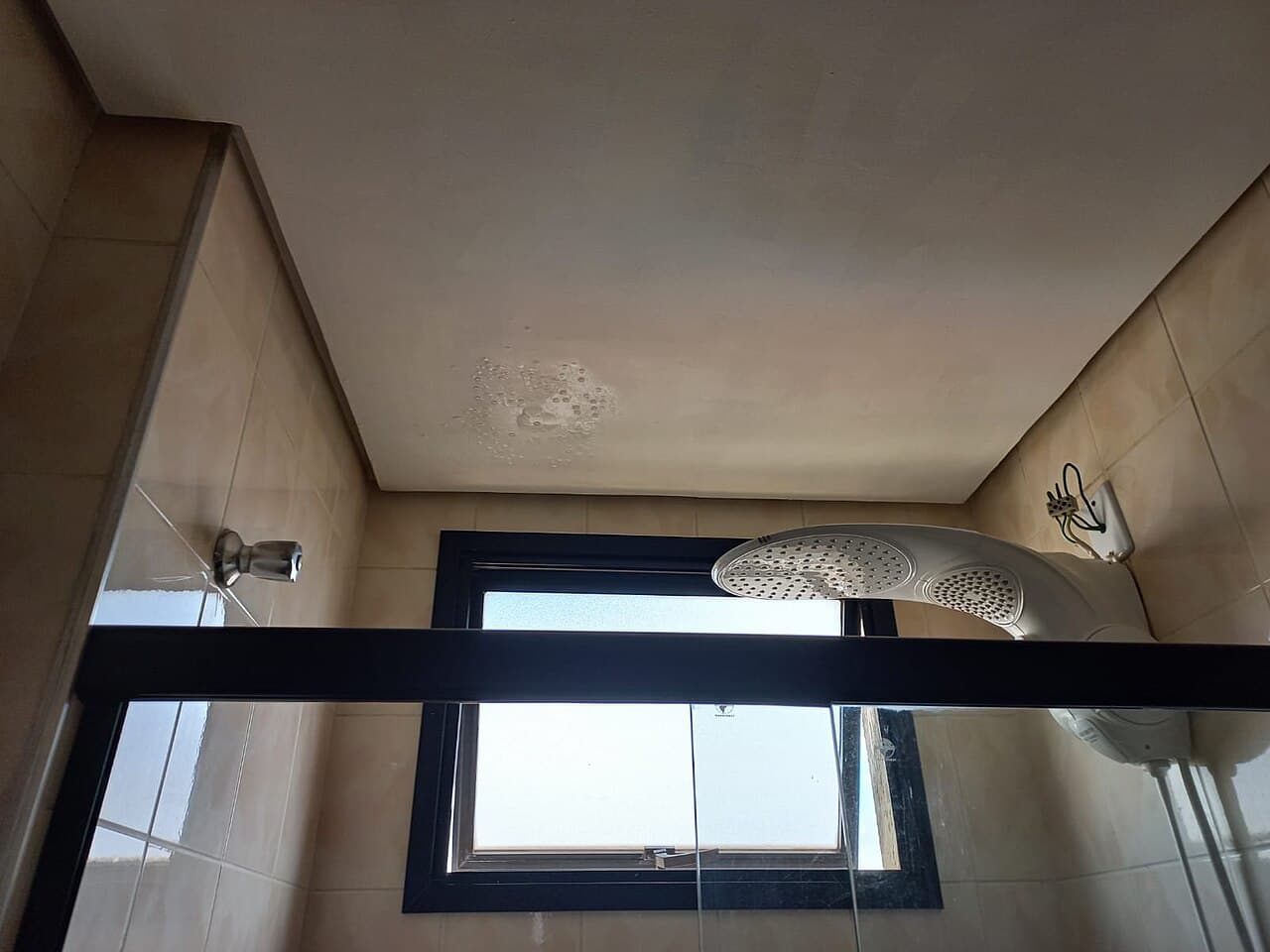
In the bathroom, the ceiling is the first place to receive shower steam. If black spots appear all over the ceiling, especially above the shower, the cause is almost always condensation: the steam has nowhere to go and stays in the air for hours.
If instead there is a localised tide mark and the upstairs bathroom sits right above, consider a leak. Both problems can coexist. For the first, what counts is an extractor fan with enough airflow and a timer — see the guide to damp in a bathroom without a window.
To clean, use diluted bleach (1 part to 4 parts water), with gloves, a mask and the door and window open, never mixed with other products. You can also use an anti-mould spray. Use biocides safely. Always read the label and product information before use.
Decision table: what to do about ceiling mould
| What you see | Floor | Most likely cause | First step |
|---|---|---|---|
| Black spots in the corners, worse in winter | Any | Condensation | Measure humidity at 7 am and air the room |
| 20–40 cm strip along the façade | Any, older building | Thermal bridge + condensation | IR thermometer and dew point |
| Tide mark after rain | Top | Water ingress via roof or terrace | Dated photos and notice to the condomínio |
| Tide mark that grows in dry weather | Middle | Leak in the flat above | Talk to the neighbour, check the meter |
| Spots over the whole bathroom ceiling | Any | Shower condensation | Extractor fan with timer |
| Drips or sagging plaster | Any | Active leak | Switch off the circuit and ask for a site visit |
If the signs point in different directions, the free diagnosis helps put numbers on it: it asks about the floor, where the patch is, how it relates to rain and your habits, and returns a probability for condensation, rising damp and water ingress. With low confidence, it recommends a technical site visit — and that is what you should ask for before any building quote.
Frequently asked questions
You can, but only after cleaning the mould, letting it dry properly and understanding the cause. Painting over live mould or a water-ingress stain hides the problem for a few weeks, then it comes back, often bigger. If the stain is from water ingress, paint can even make it harder to prove later when and where the water got in.
It depends on the path the water takes. With a broken roof tile it can be a matter of hours; through a terrace with ageing waterproofing, water can take days to cross the slab. That is why it helps to note the dates of downpours and of the stains for a few weeks: the link between the two is one of the best pieces of evidence you can gather.
As a rule, whoever has the source of the leak in their unit (fração) is responsible for repairing the damage it causes, and common parts fall to the condomínio. Often the insurers of both units settle it between themselves. Each case depends on the facts and the policies, so check with a lawyer or with DECO (the consumer association) before making demands.
It doesn't fix the cause. On a ceiling with condensation, an insulated false ceiling can raise the surface temperature and help, but if it is badly installed the condensation moves into the void, where nobody sees it. With water ingress it only hides the water, which keeps soaking the slab. Identify the cause first, then decide.
SOURCES
- Building physics: dew point (Magnus formula)
- Código Civil (Civil Code), arts. 1421, 1424 and 1427 (horizontal property)
- WHO — Guidelines for indoor air quality: dampness and mould (2009)
- Prices observed on Google.pt, cume.pt, Zaask and Habitissimo, Oct 2026