Cold home and damp: insulation, windows and heating
Cold walls are where moisture condenses. Thermal bridges, single glazing, external or internal insulation, how to heat and what to do first on each budget.
- Around 70% of Portuguese homes predate thermal insulation rules (1990): cold walls, corners and glass condense.
- Moderate, steady heating keeps walls above the dew point better than short bursts of heat.
- Start with what costs little (measure, air, window film) and leave windows and insulation until after a diagnosis.
IN THIS GUIDE
Why do cold homes have more damp and mould?
Indoor moisture only turns into water when it meets a cold surface. In a bedroom at 18 °C with 75% relative humidity, any wall, corner or pane below ~13.5 °C gets wet — that is the dew point. The colder the surfaces, the sooner this happens, and mould grows when humidity at the surface stays above ~80% for days, even without visible droplets.
In Portugal the problem is structural. Around 70% of the housing stock was built before thermal insulation rules (pre-1990). 63.2% of Lisbon residents report thermal discomfort in winter, and 32.1% of residents nationwide live in homes with damp or leaks (INE 2025) — the second-highest figure in the EU (Eurostat 2023).
In other words, damp is often not "too much vapour" but normal vapour meeting walls that are too cold. So the fix works on three fronts — removing vapour, heating better and, where possible, insulating. Before investing, confirm with the free diagnosis that it is condensation.
Thermal bridges: where the wall is coldest
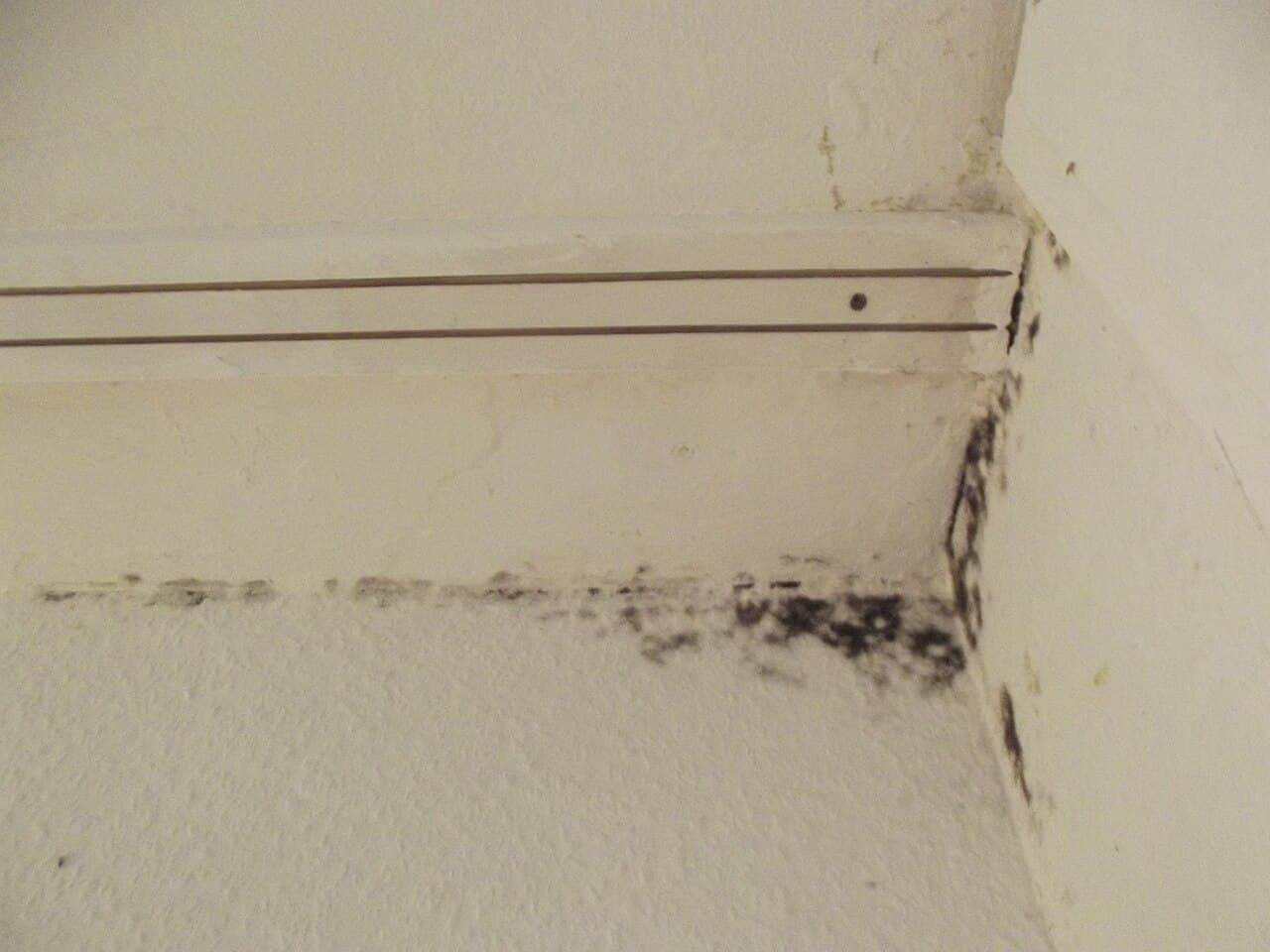
A thermal bridge is an area of the home where heat escapes faster than through the rest of the wall. That is where the first black stains appear, often in lines or sharply defined corners.
- Concrete columns and beams in the façade: concrete conducts more heat than brick, and you can see the structure's outline in the mould on the ceiling.
- Corners between two outside walls, especially in north-facing bedrooms.
- Wall-to-ceiling junction on the top floor, under poorly insulated roofs and terraces.
- Roller-shutter boxes and window lintels, which are often hollow and badly sealed.
- Balcony slabs that run from inside to outside without a break.
You can find these areas with a €15–20 infrared thermometer: in the morning, measure the middle of the wall and the corners and compare with the room's dew point. The guide how to use an infrared thermometer explains the method step by step, and the dew point calculator does the maths for you.
Single glazing and aluminium frames without a thermal break
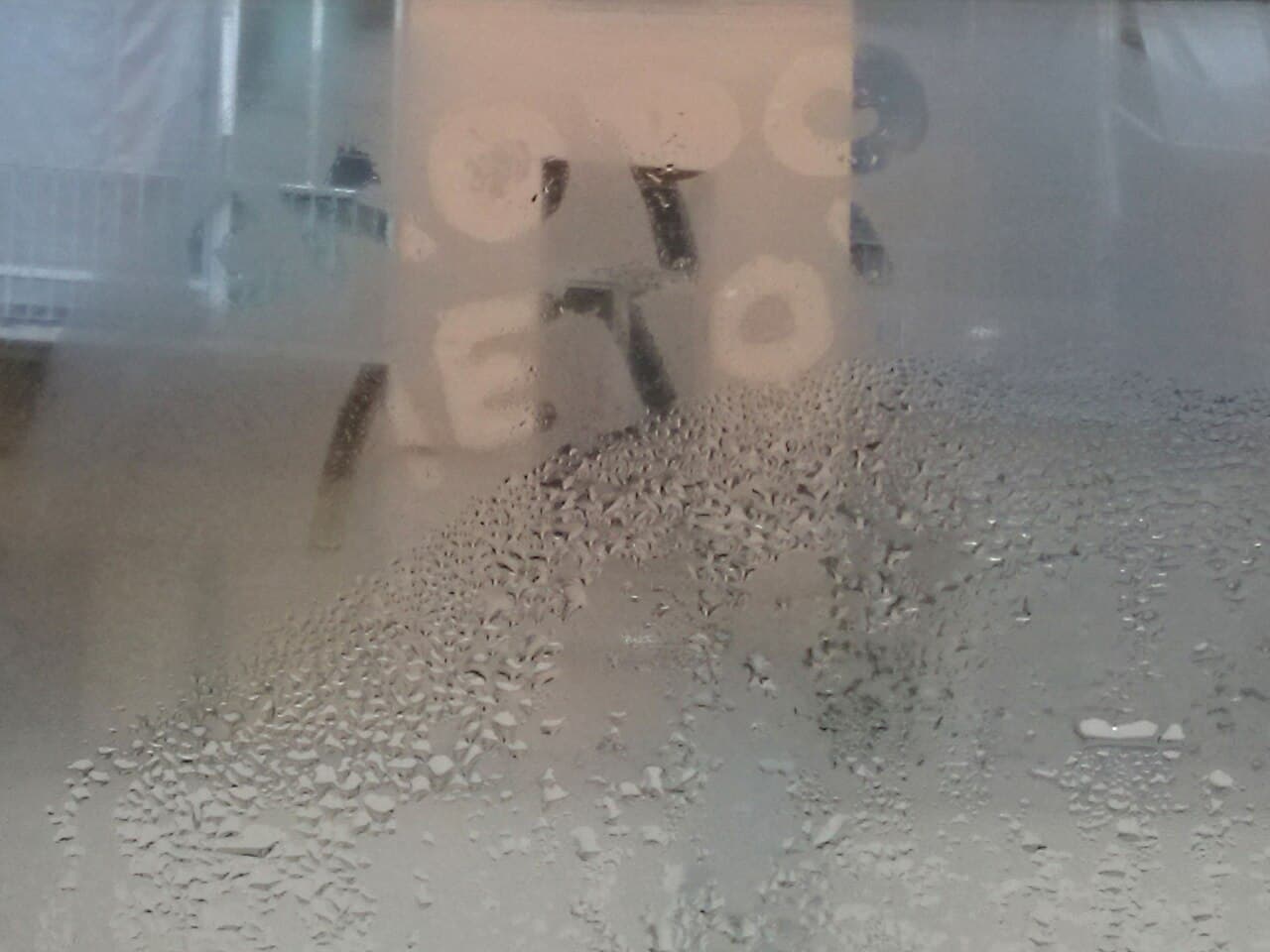
Single glazing and aluminium frames without a thermal break are the coldest surfaces in many 1960s–80s homes. They sit close to the outdoor temperature and stream with water every winter morning, which then runs onto the sill and the wall below.
- Now, without works: dry glass and frames every morning, clear the frame's drainage holes, and apply clear insulating window film (~€6).
- Curtains: keep them away from the glass and don't leave them closed in the morning; the still air between curtain and window cools and condenses.
- Replacing windows: double glazing with thermally broken frames or PVC greatly reduces condensation on the glass — but a more airtight home needs ventilation, or the moisture just moves to the walls.
Don't forget the roller-shutter boxes. In many older blocks they are hollow boxes open to the outside, letting in cold air that chills the wall above the window. Sealing the gaps and fixing thin insulation inside the cover is a small job within reach of many owners, and it reduces one of the most common thermal bridges.
The details, including what to ask window installers, are in the guide aluminium windows without a thermal break.
Insulation: ETICS outside or insulation inside?
Insulating makes indoor surfaces warmer, which tackles condensation at the root. There are two main approaches, with different advantages and risks:
| ETICS (external insulation) | Internal insulation | |
|---|---|---|
| What it is | Insulation boards fixed to the façade and finished with reinforced render | Boards or panels with insulation applied to the inside walls |
| Thermal bridges | Covers columns, beams and slabs continuously | Gaps remain at slabs and internal walls |
| Floor area | No loss | Loses a few centimetres on each wall |
| Permission | Affects the façade: usually a decision for the condomínio | Work inside the unit |
| Main risk | Workmanship and detailing around windows | Hidden condensation behind the insulation if the vapour barrier fails |
| Disruption indoors | Almost none | Means moving sockets, skirting and wardrobes |
In a block of flats the façade is a common part (Código Civil (Civil Code), art. 1421), so ETICS is as a rule a decision for the owners' meeting of the condomínio (owners' association), with costs split by permilagem (each unit's share). In a house, the decision is yours. Either way, ask for a quote after a site visit and be wary of per-m² prices given over the phone.
Insulating the top-floor ceiling or the slab under a terrace often makes a big difference to comfort, but check first that there is no water coming in through the roof — see the guide to water ingress.
Steady low heat or short bursts?
Many families heat one room for an hour in the evening and then switch everything off. The air warms quickly, but the walls barely do. When the heater goes off, the air cools against the cold walls, relative humidity rises and condensation appears in the early hours.
For damp, moderate and more constant heating in the rooms you use, especially bedrooms, works better than short, intense bursts. Walls that never get very cold stay further from the dew point. You don't need to heat the whole home to the same level: a small difference between rooms is fine, as long as doors are left ajar.
- Air conditioning (heat pump) and electric radiators: heat without adding vapour to the air.
- Flueless gas or paraffin heaters: release water vapour as they burn, so they heat but raise humidity. The guide gas heaters and damp explains why.
- Open fireplaces: heat the living room but pull cold air into the rest of the home; closed wood-burning stoves are more balanced.
A programmable thermostat helps keep this pattern without waste: turn the temperature down when the home is empty instead of switching off completely, and set the bedroom to warm up a little before bedtime and before waking, the hours when condensation usually appears.
Heating doesn't replace airing. Even in a warm home, do short air changes in the morning and after showers; the guide how to air your home in winter has a ready-made routine.
Priorities by budget: where to start
The public E-Lar and Vale Eficiência schemes have been closed since July 2026 and no new ones have been announced. So it makes sense to go step by step, starting with what gives the most result per euro:
| Budget | What to do | Expected effect |
|---|---|---|
| Up to ~€50 | Hygrometer ( | Know where and when it condenses; less water on glass |
| €50–300 | 10–12 L/day dehumidifier (from ~€90), seal shutter boxes, bathroom extractor | Humidity below 60–70% in the worst rooms |
| ≈€800–2,500 | VMI in a flat (estimate) | Air change throughout the home, independent of habits |
| Major works | Thermally broken windows, roof insulation, ETICS | Warmer walls and glass; quote only after a site visit |
The first two rows are observed retail prices; the bigger works depend on each home. For ventilation prices, see how much a VMI costs.
Cold homes, damp and health: without alarmism
A cold, damp home is uncomfortable and encourages mould, which can worsen respiratory symptoms in sensitive people. That doesn't mean every stain is dangerous, but it does justify tackling the cause calmly and methodically rather than painting over it. The guide damp and health sums up what the evidence says.
If you have a quote for works — windows, insulation or ventilation — and aren't sure it addresses the right problem, you can ask for a free second opinion. Expensive works that don't tackle the cause of the damp are money wasted.
Frequently asked questions
There is no single number: it depends on air humidity and wall temperature. What matters is that the coldest surfaces stay above the dew point. For example, with 75% humidity in the bedroom at 18 °C, walls need to be above ~13.5 °C. Measure with an infrared thermometer and use the calculator for your case.
Paints with thermal additives go on in very thin coats, and their effect on wall temperature is limited compared with real insulation. They may help with appearance and cleaning, but they don't replace ventilation, adequate heating or insulation. Be wary of promises of results equivalent to building work.
It can, if the home becomes more airtight without ventilation or if internal insulation is poorly installed. New windows and insulated walls reduce cold surfaces, but also the gaps through which air used to change. So any insulation work should include a ventilation solution, even if only trickle vents in the frames and effective extractor fans.
It depends on the building's rules and the impact on the façade. Windows belong to the unit, but the façade is a common part and many building regulations require keeping the same colour, material and design. As a rule, check with the building management before ordering and keep the answer in writing. If in doubt, consult a lawyer or DECO.
SOURCES
- INE — Survey on Income and Living Conditions, 2025 (via idealista); Eurostat 2023
- Housing stock built before 1990 and thermal building regulations
- Building physics: dew point (Magnus formula)
- Código Civil (Portuguese Civil Code), art. 1421; public information on E-Lar and Vale Eficiência (closed, July 2026)
- Prices observed in retail and on Google.pt, cume.pt, Zaask and Habitissimo, Oct 2026